


News and innovation
The project Robot & Grazing? For each other! is an initiative of
NAJK, Netwerk GRONDig and Aeres University of Applied Sciences.

High milk production and grazing are compatible when using robotic milking systems
News item
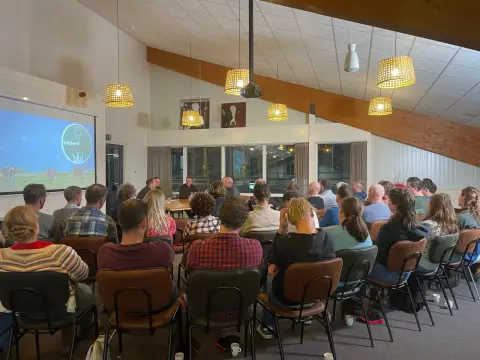
Producing over 11,000 kilos of milk per cow while also achieving more than 1,000 hours of grazing time—all with the help of robotic milking systems. Pieter Overeem demonstrates that it is possible. His farm management approach was one of the real-world examples showcased during the national meeting of the "Robot & Grazing? It Works!" (*Robot & Weiden? Voor Elkaar!*) initiative, held on Thursday, November 19, in Zwartsluis. The key takeaway from the day: successful robotic milking and grazing require deliberate choices, a well-suited grazing system, and a willingness to keep learning.
High production with fresh grass
Combining high milk production with pasture access is a challenge for many dairy farmers. During a well-attended workshop, Pieter Overeem demonstrated that it is indeed possible. On his farm, which houses 130 dairy cows and two milking robots, he achieves a rolling annual average of 11,300 kilograms of milk per cow. At the same time, his cows spent 163 days out in the pasture last season, totaling 1,041 hours of grazing.
His approach centers on carefully balancing the indoor ration with the grass available outdoors. In the morning, the feed bunk is left empty, and the cows are given access to the pasture between 5:00 AM and 10:00 AM. They are also let out again between 5:00 PM and 9:00 PM. On average, the cows consume about 4 to 5 kilograms of dry matter from fresh grass per day.
According to grazing coach Ap van der Bas, fresh grass offers distinct advantages, even—or especially—when milk production is high. It has a high nutritional value, can reduce feed costs, and requires less processing than ensiled grass. This is reflected in concentrate purchases: the fresh grass allows for savings on protein in the ration. Furthermore, he emphasizes the importance of grazing young stock. Getting young animals accustomed to pasture at an early stage lays a vital foundation for successful grazing once they become dairy cows—a factor that is particularly important in systems using robotic milking.
Choose a system and give it time
Dairy farmers Jan Vonk, Albertine Ekkels, and Wytze Kinderman—who serve as ambassadors for the practice—shared their experiences. A key lesson: choose a grazing system that suits your specific farm, and give your cows time to adapt to it.
Jan Vonk, who began using an automated milking system (robot) for the first time last year, advised against constantly switching systems. Instead, he suggests evaluating the approach only after the grazing season has concluded and making adjustments where necessary. Starting the grazing season early and ensuring the availability of palatable grass are also crucial factors for success.
Grass quality plays a significant role as well. Wytze Kinderman emphasized that palatable grass is especially important when cows have to travel longer distances to reach their pasture plots.
Keep learning from each other’s experiences
Even experienced graziers encounter challenges—such as determining the optimal time for mowing, managing walking distances and routing to pasture plots, and striking the right balance between grazing and milk production. The dairy farmers therefore underscored the value of exchanging knowledge: "Talk to others; you’ll gain new insights—even if you think you already have all the answers."
Inspiration was also drawn from beyond national borders. Irish dairy farmer and consultant Patrick Gowing demonstrated how he integrates automated milking with a grazing system centered on fresh grass. His experiences offered a fresh perspective on economic decision-making and the overall organization of a dairy farm.
The "Robot & Grazing" meeting brought together dairy farmers, grazing coaches, and experts to facilitate the exchange of knowledge and explore practical solutions. The day concluded with a live recording of the VeeteeltGRAS podcast and a tour of the dairy farm Weidevol.
Watch or listen to the podcast here.
In 2027, Robot & Weiden will once again organize activities where dairy farmers can exchange experiences. Find more information and sign up here.
Curious about the developments?
Sign up for news about our project.
Contact
Nederlands Agrarisch Jongeren Kontakt
Smallepad 32 – Wing 1, Floor 6
3811 MG Amersfoort
The project ‘Robot & Grazing? Let's do it!’ is an initiative of the Working Group Meerweiden and is carried out by NAJK, Aeres University of Applied Sciences, and Network GRONDig.


