


News and innovation
The project Robot & Grazing? For each other! is an initiative of
NAJK, Netwerk GRONDig and Aeres University of Applied Sciences.

No more moving fences? The Collie technique
News item
The 'Robot & Pasture' project focuses on identifying and testing monitoring systems that objectively record the number of hours spent grazing. One of the five systems we are testing is Collie. In addition to tracking grazing hours, Collie offers the added benefit of virtual fencing technology—essentially an invisible fence. Naturally, eliminating the need to install or move posts and wire saves a great deal of time.
Collie uses tags attached to the cows' collars that employ GPS to pinpoint their exact location. Through the app, you can specify which part of a given field the cows are allowed to graze on that day. If they approach the virtual fence, they are warned by an audible signal. This signal intensifies as they get closer to the boundary. If they still do not turn back, they eventually receive a mild electric shock. Notably, this shock is (much) weaker than what they would experience if they tested a standard electric wire. Within a few days, the cows learn to respond to the audio signals, meaning they rarely receive shocks—much like how most quickly learn to avoid an electric wire once they see it.
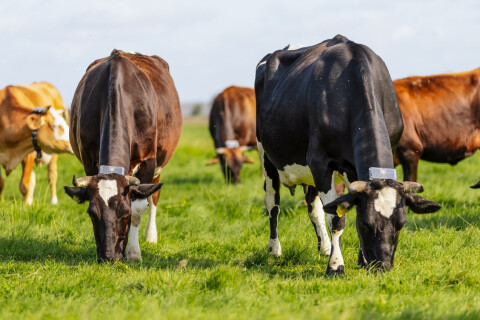
The Collie system is currently being tested as part of the Robot & Weiden project. We are verifying whether the data provided by the system is accurate. Did the amount of time spent at pasture actually match what the system reported? Did that specific cow really go out at that time and come back in later? The team behind Collie is working to get their system included on the 'Witte Lijst' (White List) maintained by the Stichting Weidegang (Pasture Grazing Foundation). Once the system is listed, it will be accepted as a valid means of documenting the number of hours cows have spent at pasture on the farm throughout the season.
Curious about the developments?
Sign up for news about our project.
Contact
Nederlands Agrarisch Jongeren Kontakt
Smallepad 32 – Wing 1, Floor 6
3811 MG Amersfoort
The project ‘Robot & Grazing? Let's do it!’ is an initiative of the Working Group Meerweiden and is carried out by NAJK, Aeres University of Applied Sciences, and Network GRONDig.


