


News and innovation
The project Robot & Grazing? For each other! is an initiative of
NAJK, Netwerk GRONDig and Aeres University of Applied Sciences.

Results of in-depth interviews and survey on motivation
News item
Why do dairy farmers using milking robots deliberately choose to let their cows graze, while others do not? As part of the project *Robot & Weiden? Voor elkaar!* (Robots & Grazing? A Perfect Match!), we conducted in-depth interviews with dairy farmers. The farmer's motivation emerged as the common thread. Technology, infrastructure, and robot capacity are important, but ultimately, it is the farmer who determines the importance of grazing within the farm operation.
But what exactly motivates the dairy farmer?
To gain more insight into this, we conducted an online survey among approximately 300 dairy farms using milking robots, asking farmers about the opportunities and drivers they see for grazing on their farms. The results were striking (see Figure). It is often assumed that financial benefits are the primary motivation, but the study did not bear this out. Instead, the positive image of dairy farming was most frequently cited as a key driver. Many farmers consider it important for the public to see cows grazing outdoors. Grazing helps maintain a connection with society and fosters trust in the sector.
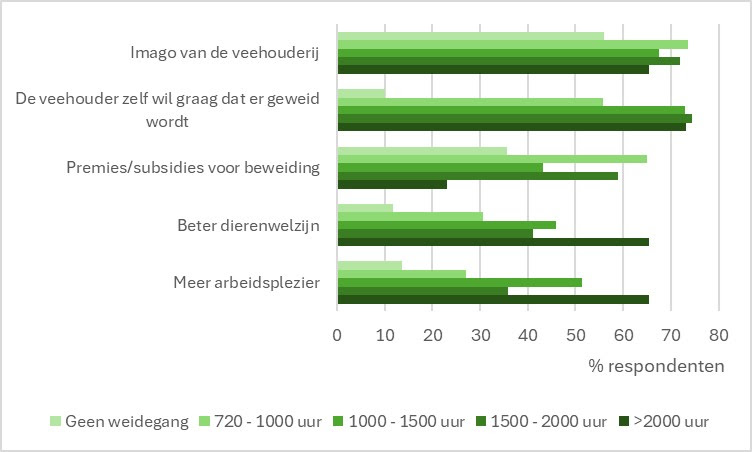
The positive image of the dairy sector is most frequently cited as a key driver for grazing.
Alongside the sector's image, intrinsic motivation played a major role. Of the more than 300 dairy farmers using milking robots (both those who graze their cows and those who do not), 74% agreed with the statement: "At heart, I am a proponent of grazing." Only 11% disagreed. Farmers who actively graze their herds on a large scale, in particular, indicated that they enjoy seeing their cows outdoors and make a conscious choice to do so.
These findings align with previous research showing that grazing is often linked to personal convictions and the farmer's vision regarding good husbandry and professional standards. Grazing is therefore not just about production or efficiency; it is also about pride, identity, and the image a farmer wishes to project for their business.
Premiums and subsidies for grazing were certainly mentioned, though primarily by farmers who do not graze their herds or those with relatively limited grazing hours. Farmers who already graze extensively attached less importance to financial incentives. This suggests that economic benefits serve mainly to reinforce a motivation that is already present.
Animal welfare and job satisfaction also frequently emerged as important reasons for grazing. Farmers view grazing as natural behavior for cows, for instance, and report greater enjoyment in a system where cows spend time outdoors.
There are plenty of opportunities for grazing, then—even on farms using milking robots.
Many farmers demonstrate that robotic milking and pasture grazing can work very well together. Insights from peers, new knowledge, and practical solutions help make grazing increasingly compatible with a wide range of farming styles and operational situations.
Curious about the developments?
Sign up for news about our project.
Contact
Nederlands Agrarisch Jongeren Kontakt
Smallepad 32 – Wing 1, Floor 6
3811 MG Amersfoort
The project ‘Robot & Grazing? Let's do it!’ is an initiative of the Working Group Meerweiden and is carried out by NAJK, Aeres University of Applied Sciences, and Network GRONDig.


