


News and innovation
The project Robot & Grazing? For each other! is an initiative of
NAJK, Netwerk GRONDig and Aeres University of Applied Sciences.

For Irish livestock farmers, robotic milking and grazing are a piece of cake.
News item
In Ireland, milk production is based on pasture grass. Most farmers employ a system of block calving, whereby all cows calve within a period of a few weeks starting in early February. The fresh cows go out to pasture day and night as soon as possible. To have a pasture cut available early in the season, farmers start harvesting grass as early as autumn that survives the relatively mild Irish winter unscathed.
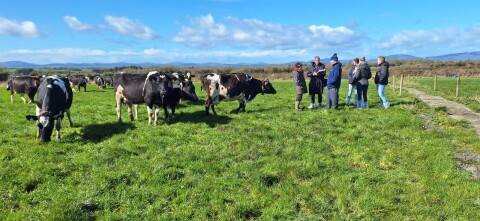
Milking on only pasture grass and a few kilos of concentrates is not easy to combine with automatic milking. Nevertheless, there are farmers in Ireland who show that it is possible. At the end of March, the ‘Robot and Pastures’ project organized a study trip to the green island. Four Dutch dairy farmers put on their boots and braved the rain showers to see how their Irish colleagues manage this.
Weekly pasture walks
The success of the combination of robotic milking and grazing depends on the grazing system. Irish robotic milkers use ABC pastures. To achieve this, the pasture platform for the dairy cows is divided into three (as much as possible) equal blocks. Every eight hours, the cows are given access to a fresh patch of grass in the A-block, the B-block, and the C-block in succession. After 24 hours, a new patch is available in the A-block. The size of a patch is tailored to the grass supply and the number of cows. Consequently, the patches are constantly being recreated using flexible posts and wire. Moving wires is daily work for Irish robotic milkers, and they take a pasture walk with a grass height meter at least once a week. The data is recorded on a phone app that helps to match the grass supply and the cows' intake as closely as possible.
New pasture as an action stimulus
The depletion of grass in a small pasture, combined with access to a new small pasture, acts as the stimulus for the cows to get moving. Therefore, matching grass supply to demand requires careful attention. If the surface area of a pasture is too small, the cows cannot consume enough grass, which comes at the expense of production. However, if a pasture is too large, there is no incentive for the cows to start walking.
The trick to getting the cows to the robot is that they must first go to a pen with selection gates near the barn before they can go to a new pasture. Cows that are due for milking are sent to the robots through the selection gates in this pen, after which they can only go to the pasture once they have been milked. Cows that do not need to be milked for the time being go directly to the new pasture via the selection gate. With this system, Irish robotic milkers achieve an average of around two milkings per cow per day, with an average production of between 5,000 and 6,000 kg of milk per cow per year. A variation on traditional ABC grazing with day and night grazing is a system in which the C-block is filled with supplementary feeding of freshly mown grass or silage in the barn, often at night. This system is applied particularly to farms with a limited home plot and therefore may be a better fit for Dutch conditions than traditional ABC grazing.
Proper preconditions essential
To make ABC pastures a success, it is important that the preconditions at the robotic farm are in order. For example, direct access to all plots via field paths is essential, while care must be taken to prevent plots from becoming too long and too narrow. This leads to unnecessary trampling and increased foot traffic during wet periods. Therefore, the decision is sometimes made to split a block into two blocks using an extra field path. Water supply also requires extra attention in ABC pastures. Water troughs are preferably placed along the field paths to maintain flexibility in the plot layout. Furthermore, cows must always have access to drinking water within a short distance of a plot.
Curious about the developments?
Sign up for news about our project.
Contact
Nederlands Agrarisch Jongeren Kontakt
Smallepad 32 – Wing 1, Floor 6
3811 MG Amersfoort
The project ‘Robot & Grazing? Let's do it!’ is an initiative of the Working Group Meerweiden and is carried out by NAJK, Aeres University of Applied Sciences, and Network GRONDig.


